Gait & robotics
Upper-limb robotics after stroke: choosing a system
Decide which arm or hand task you need to train. Reaching, elbow movement and hand practice require different support, and a repetition count alone cannot show recovery.
Specify the movement
Identify the joints and activities the programme will address. Ask whether the model provides assistance, resistance, feedback or measurement. ERGO, LIFT and VISION should be compared using their current documented functions.
Positioning matters too. Seating, trunk support and joint alignment can change how a patient performs the task and how much help the therapist needs to provide.
Read the impairment score alongside daily function
The portable-robot review linked below included nine studies with 295 participants; eight contributed to its meta-analysis. It examined upper-limb impairment with the Fugl-Meyer Assessment.
An improvement on that scale does not, by itself, show independence in dressing or other daily tasks. Check the training programme, therapy dose and comparison group before explaining what the result means.
Test the task and the report
During a supervised demo, assess setup, access and how task difficulty changes. Ask how the therapist identifies compensatory movement. Visual feedback needs a clinical purpose.
Pair the device’s report with a functional outcome suited to the patient. Check software costs, data export, cleaning, training and support before purchasing.
Before you decide
- Exact joints and tasks supported
- Comparable therapy dose in clinical studies
- Patient positioning and therapist access
- Functional outcomes and follow-up
- Software, training and maintenance scope
RELEVANT REHAX EQUIPMENT
Products discussed in this article
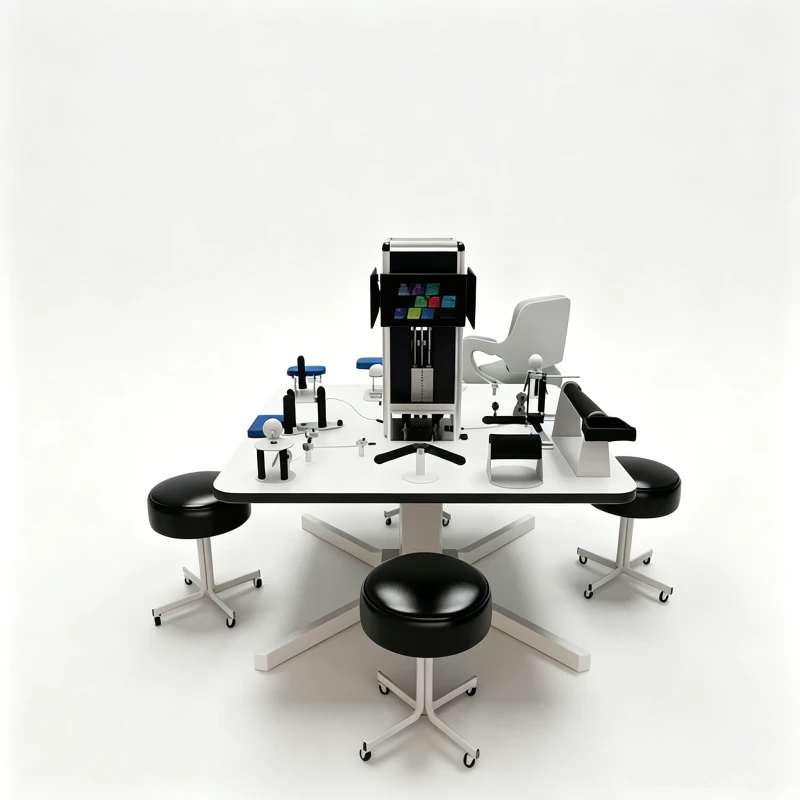
ERGO
Mechanical occupational therapy table for hand, wrist and forearm movement, with ERGO LIFT and ERGO VISION model options.
Product details →Questions & answers
Do more repetitions guarantee arm recovery?
No. Task relevance, patient engagement, clinical suitability and the wider programme matter. Repetition count is a process measure rather than a guaranteed outcome.
Are all upper-limb robots interchangeable?
No. Assistance methods, supported movements, fit and evidence differ between systems.
References
Check the original population, methods and follow-up before applying a finding. These sources do not establish that a ReHAX product was used unless the study identifies it.
- Systematic reviewPortable robots for upper-limb rehabilitation after stroke: a systematic review and meta-analysis ↗
Varied devices and training methods; not ERGO, LIFT or VISION product validation.