Gait & robotics
Overhead body-weight support: layout and equipment planning
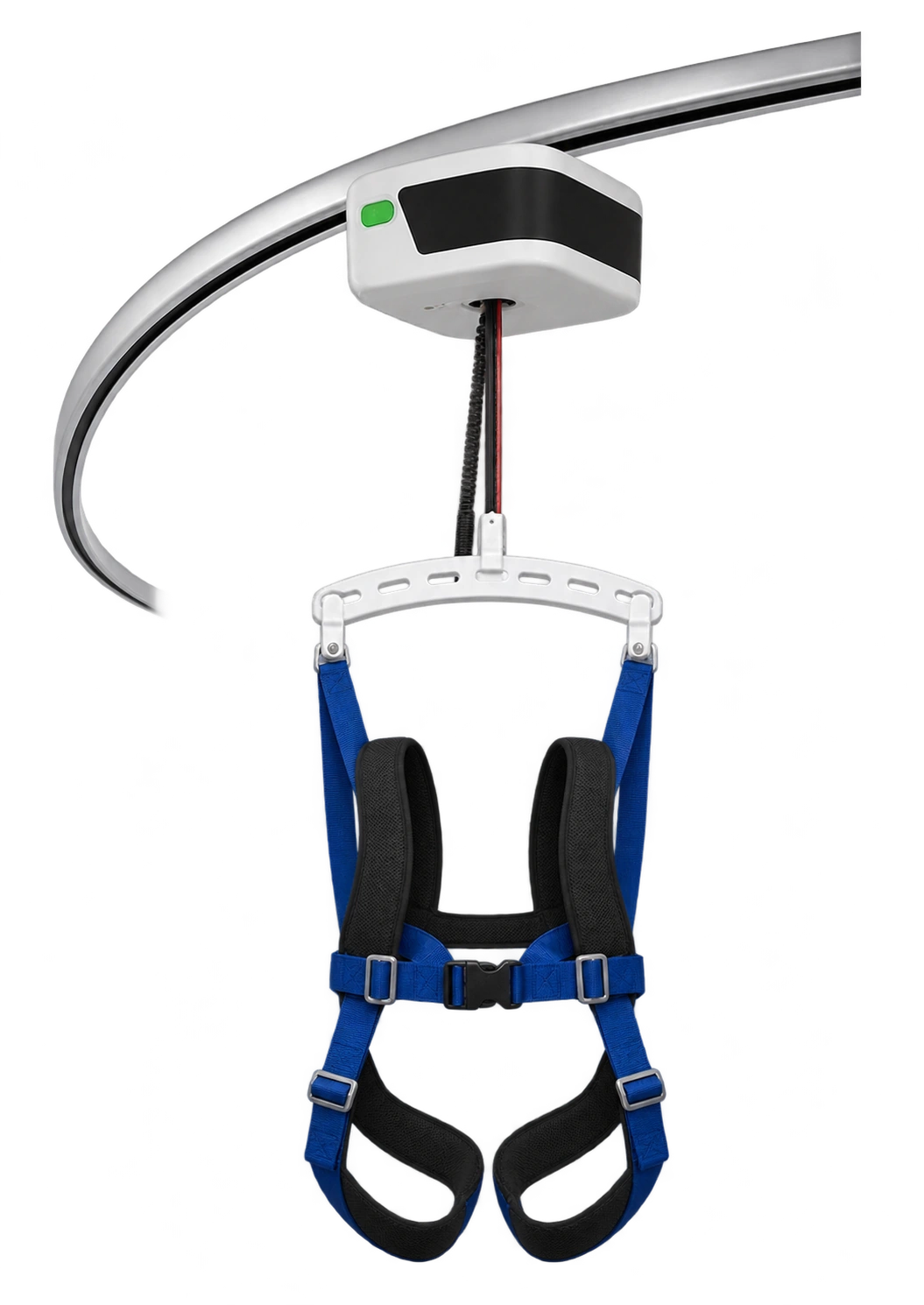
Plan an overhead support system around the activities patients will practise. Track coverage, harness fitting and transfer space determine whether the installation works for the clinical team.
Specify what support you need
Unloading, fall protection and transfer assistance are different functions. Confirm which functions the model provides and under what limits. Static and dynamic systems also respond differently during movement.
A harness connected to an overhead structure does not, by its name alone, establish a fall-protection capability. The instructions and installation design must support the task.
Read the overhead study for its population
Bannwart and colleagues tested mediolateral damping with the FLOAT system in 21 able-bodied volunteers. The study investigated stability during treadmill walking.
That is a useful engineering question, but it does not establish recovery in patients or the performance of ZEVYA. The body-weight-support review below covers a broader set of interventions.
Map the room before installation
Mark walking, turning, balance practice and transfer positions on the plan. Include therapist access, harness storage, clearances and emergency access. Have the installation and clinical teams review the same tasks.
Obtain the structural assessment and approved installation plan required for the specific system. Request ZEVYA’s user limits, inspection schedule and training requirements, then observe fitting, stopping and removal during a demo.
Before you decide
- Defined support and protection functions
- Clinical task and track layout
- Structural and installation review
- Harness fitting and emergency training
- Inspection and maintenance responsibilities
RELEVANT REHAX EQUIPMENT
Products discussed in this article
ZEVYA
Overhead body-weight support for gait, balance and functional mobility, with ceiling-track planning and five model options for adult and paediatric rehabilitation.
Product details →Questions & answers
Does body-weight support mean a patient cannot fall?
Do not infer that from the category name. Confirm the protection functions, limits and operating instructions of the specific system.
Can one support system serve every patient?
Patient fit, clinical suitability, activity and manufacturer limits vary. Select the system and harness after assessment.
References
Check the original population, methods and follow-up before applying a finding. These sources do not establish that a ReHAX product was used unless the study identifies it.
- Systematic reviewEffects of body weight support training on balance and walking function in stroke patients: a systematic review and meta-analysis ↗
Includes varied support interventions; does not establish equivalence between air-pressure, harness and robotic systems.
- Original researchMediolateral damping of an overhead body weight support system assists stability during treadmill walking ↗
Research in 21 able-bodied volunteers using the FLOAT system; not evidence of patient outcomes or ZEVYA product validation.